Last week, I had the opportunity to introduce the concept of the Circular Economy during a prototyping week. I shared a short input , just five minutes to present the core principles, and created an assesment questionnaire to help participants reflect on how circular thinking could fit into their emerging ideas.
From this experience, I’m taking away two main insights:
1. Circular Economy is still not a familiar concept for many.
Although my presentation was concise and aimed at giving a clear overview, I quickly realised that the term Circular Economy itself is not yet well understood or deeply rooted.
My questionnaire, which I had designed for an audience already somewhat familiar with the topic, turned out to be too advanced. I had to adjust it three times along the way. This showed me that the foundations of circular thinking still need more accessible explanations before people can confidently apply them.
2. Timing and visibility matter.
When a module or presentation isn’t part of the main event announcement, or when it doesn’t come with recognisable incentives such as continuing education credits or ECTS relevance, its perceived importance drops.
This was also reflected in the relatively low participation in the questionnaire. The answers I did receive were valuable and provided meaningful insight into how early-stage projects relate to circularity, but the low response rate highlighted a broader issue: without early, clear framing, circularity easily slips into the background.
In summary
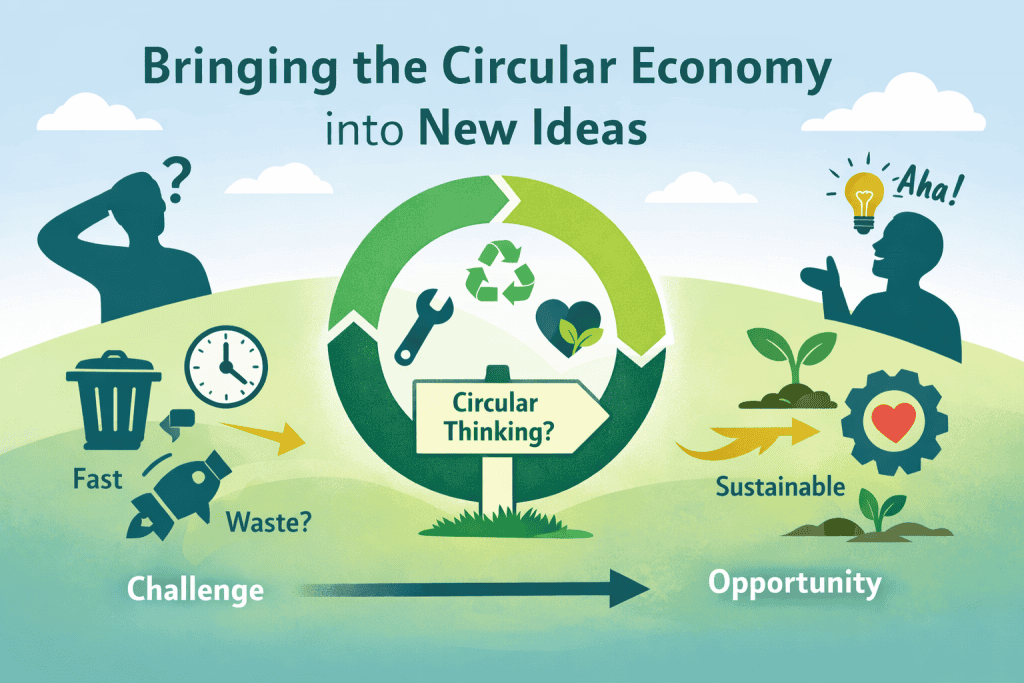
Circular Economy is not yet widely understood, and therefore, it’s not naturally integrated into new ideas or development processes.
In a fast-paced environment where actions often need a clear personal benefit, circularity can seem abstract or secondary.
But it isn’t. Circular Economy is not a luxury or an add-on; it is increasingly a necessity for our future.
My next step is to make circular thinking more accessible, more intuitive, and easier to integrate, right from the start of any creative or entrepreneurial journey.
